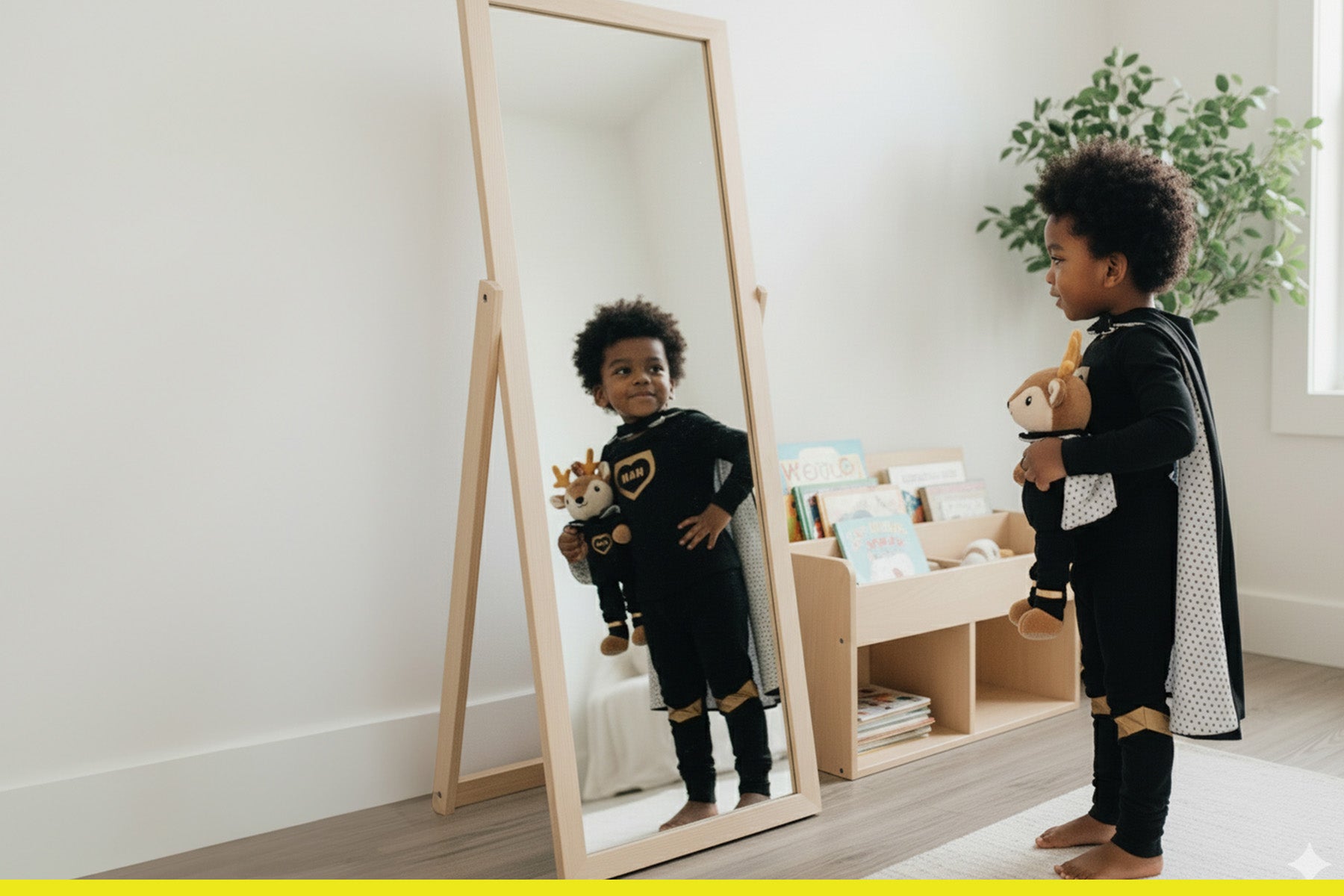
What a Cape Does to a Child's Brain
When children put on a cape, crown, uniform, or pair of grown-up shoes, they are doing more than pretending to be someone else. They are giving shape to qualities already living inside them—courage, care, curiosity, leadership, imagination—and discovering how those qualities feel when they move through the world.
A cape does not make a child a hero. It helps a child see the hero that is already possible within them.
A child in a doctor’s coat may begin caring for everyone’s health. A child with a chef’s hat may create a meal for the whole family. A child in a cape may rescue, protect, comfort, include, and lead. The clothing gives an inner quality an outer form. It turns an invisible feeling into something a child can see, feel, and embody.
This is one reason dress-up play is such a powerful part of childhood.
Clothing Gives Imagination Something to Hold On To
Children’s pretend play often begins with an idea: “I’m a superhero,” “You’re the patient,” or “This is our restaurant.” Clothing and props give those ideas a physical form.
Putting something on can help a child move from imagining a character to embodying a quality. The cape becomes a signal that it is time to fly, rescue, protect, or help—not because the child has become somebody else, but because the costume helps them recognize and express something intrinsic in themselves.
A hat can turn an ordinary chair into a fire engine or a living room into a hospital. A cape can transform a child’s posture, voice, and sense of possibility. It gives courage somewhere to land.
These objects act as invitations to play. They help children build a shared world and make abstract ideas easier to explore, feel, and practice.
Dress-Up Can Change the Way Children Carry Themselves
Have you ever noticed a child stand taller after putting on a costume? They may speak more confidently, move with greater purpose, or take on responsibilities they would not usually choose.
Psychologists sometimes describe this as an example of “enclothed cognition”: the idea that what we wear can influence how we think, feel, and behave. Clothing can carry meaning. When children put on something associated with courage, care, leadership, or adventure, they may begin to act in ways that reveal those qualities within them.
The change is not magic, and it does not mean a costume determines a child’s personality. Instead, the clothing creates a context in which certain parts of the child feel visible, available, and possible.
The cape does not give the child a new identity. It helps them step more fully into their own.
Children Learn Through Embodying Characters
Pretend play gives children a safe way to practice skills and emotions. When a child plays the role of a superhero, they might explore bravery. When they play a caregiver, they might practice empathy and responsibility. When they become a teacher, they might experiment with explaining, organizing, and leading.
The child is not simply copying an adult or fictional character. They are interpreting the role and making it their own. They are asking, through movement and imagination, “What does this quality look like in me?”
This process can help children ask important questions:
- What does a brave person do?
- How does a caring person help?
- What does a leader sound like?
- How can I protect someone?
- What should I do when a friend feels afraid?
Through play, children can explore these questions without the pressure of getting everything right. They can try on courage, kindness, strength, and responsibility until those qualities begin to feel less like costumes and more like parts of themselves.
A Cape Can Represent Care as Strength
Many children’s stories define strength as speed, power, or winning. Dress-up play can broaden that idea.
A cape can represent the person who notices when someone needs help, comforts a friend, includes someone in a game, or makes another person feel safe. These actions may look ordinary, but children often experience them as meaningful forms of power.
When a child puts on a cape and chooses to be a helper, they are exploring the idea that kindness is active. Caring is something a person can do. It can require courage, attention, patience, and imagination.
The heart on a cape can make that message visible: the child is not pretending to be somebody else. They are embodying the heart they already carry—the part of them that wants to protect, connect, repair, and help others feel less alone.
That message becomes especially powerful when children are given room to define what their character stands for.
Play Helps Children Recognize Different Parts of Themselves
Childhood is a time of constant discovery. Children are learning what they enjoy, what they can do, and how they want to relate to other people.
Dress-up play gives them a low-risk way to bring different parts of themselves forward. A quiet child may discover their leadership. A child who often relies on adults may experience their capacity to care for others. A child who feels nervous in a new situation may find a way to approach it with confidence.
These roles do not have to become permanent. The value is not in becoming someone else. It is in discovering more of who they are.
Each new character can reveal another possibility already within the child: the protector, the comforter, the explorer, the problem-solver, the friend who notices, the leader who makes room for others.
Adults Can Support the Story Without Taking It Over
The most meaningful dress-up play is usually child-led. Adults can provide open-ended clothing and props, then follow the child’s ideas.
Instead of deciding what the costume means, try asking:
- Who are you today?
- What does your character do?
- Who needs help?
- What makes your character brave?
- How does your character make others feel safe?
- What is already inside your character’s heart?
These questions encourage children to develop the story and recognize the qualities they are exploring.
It is also important not to limit costumes by gender, personality, or expectation. Every child should be free to play the hero, caregiver, explorer, scientist, leader, or anything else they imagine—and to discover that none of these qualities belong only to someone else.
The Meaning Is Bigger Than the Costume
A cape is only a piece of fabric. Its power comes from the story a child creates around it—and from the inner qualities that story brings forward.
When children put on clothing connected to a character, they may feel more confident entering the world of pretend play. They can practice courage, empathy, responsibility, and creativity. They can discover that strength may look like helping, listening, protecting, telling the truth, or making space for someone else.
That is the deeper psychology behind dress-up: children use objects to make inner qualities visible, then use play to feel those qualities in their bodies. They are not pretending to be somebody else. They are practicing how to be more fully themselves.