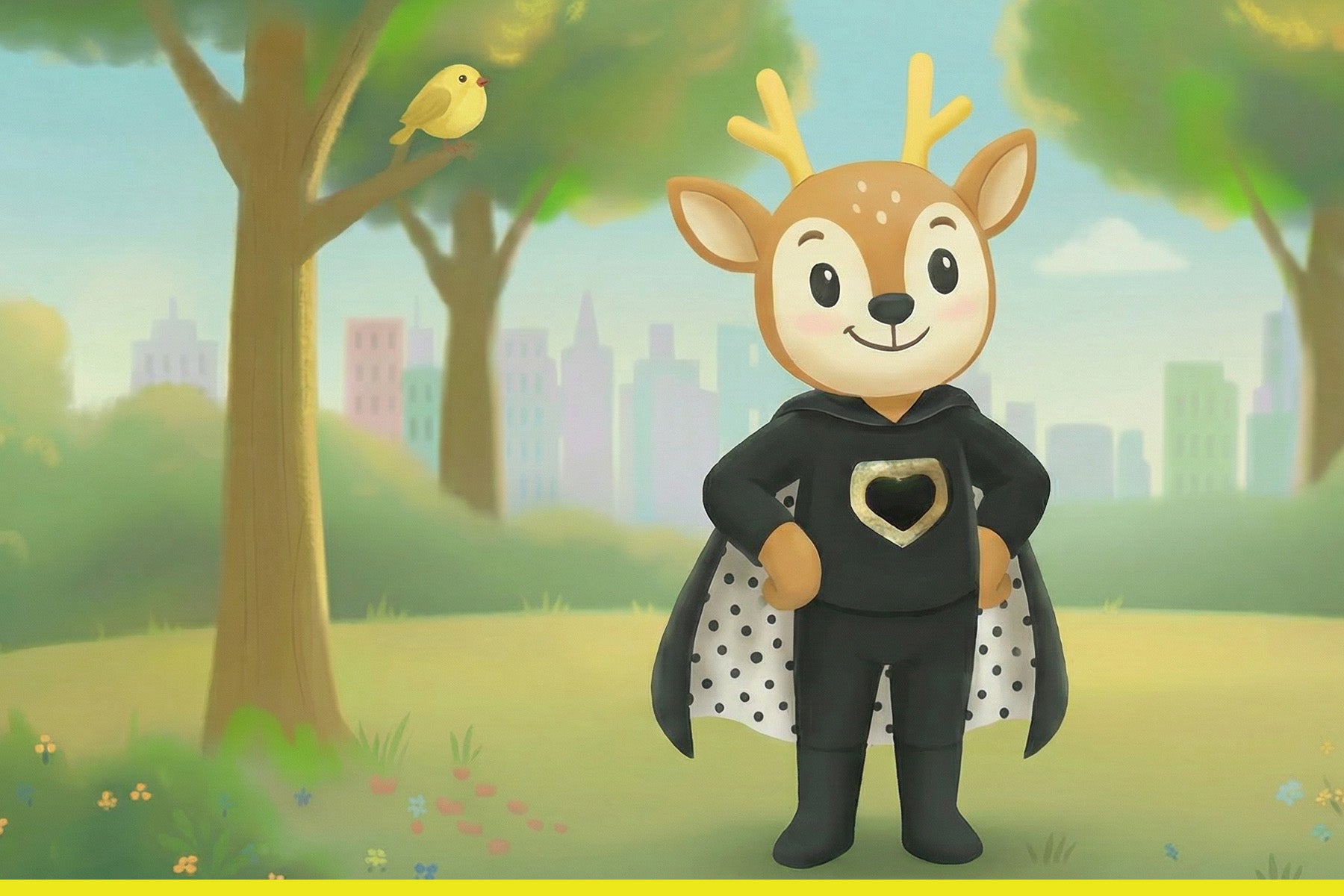
Meet Hartie: The Power Pal
At first glance, Hartie is a plush companion. Children hug him, sleep beside him, bring him on adventures, and carry him through the ordinary moments of childhood. Like many beloved companions, he quickly becomes part of a child's everyday world. But Hartie was never designed to be just another stuffed animal. He was intentionally created as a companion to the Hero Mindset—a tangible reminder of ideas that can otherwise feel abstract to a young child.
Hartie is a superhero deer from Heroville. The deer has long been associated with a unique balance of qualities. It is both gentle and strong. It moves through the world with awareness, resilience, grace, and quiet confidence. Unlike many animals that symbolize power through dominance or aggression, the deer represents a different kind of strength—one that is grounded in compassion, sensitivity, and courage.
That distinction lies at the heart of the Hero Mindset.
Children are often surrounded by messages that equate strength with being the fastest, the loudest, the toughest, or the one who saves the day through extraordinary abilities. While those stories can be exciting, they tell only part of the story. We believe true strength is much broader. It includes kindness. It includes empathy. It includes emotional well-being, self-control, perseverance, honesty, and the courage to keep going when something feels difficult. True strength isn't measured by power over others. It is reflected in how we respond to life's challenges—with courage, compassion, perseverance, and kindness.
Hartie was designed to embody that definition of strength.
From the beginning, we never wanted Hartie to be the hero of the story. We wanted him to become a companion who helps children discover that they already are.
That philosophy comes to life in Hello Hero. Rather than telling the story of a character with extraordinary powers, the book continually turns the child's attention back to themselves. Hartie arrives with a simple message: the child is the one with the special powers. Throughout the story, children are invited to recognize that heroism isn't something reserved for comic books or grand adventures. Heroism is found in everyday moments—telling the truth when it's difficult, asking for help, including someone who feels left out, helping at home, taking a deep breath before reacting, persevering after disappointment, and choosing kindness again and again.
This approach reflects what we know about early childhood development. Young children learn about themselves not simply through instruction, but through relationships, play, repetition, and the stories they tell about who they are becoming. Developmental psychologists have long observed that children naturally form meaningful attachments to symbolic companions. A favorite stuffed animal or blanket often becomes much more than a toy. It accompanies children through transitions, unfamiliar experiences, moments of uncertainty, and emotional challenges, providing a sense of familiarity while helping them make sense of experiences that are still difficult to put into words.
Hartie was intentionally designed within this tradition, but with an additional purpose. Rather than serving only as a source of comfort, he gives children a language for understanding themselves. He reminds them of what we call their "powers to hero"—their power to be kind, their power to do hard things, their power to persevere, their power to help others, and their power to make a positive difference.
Over the years, families began sharing stories that we never anticipated. Children took Hartie to doctor's appointments, blood tests, dentist visits, hospital procedures, first days of school, and family trips. Parents described children squeezing Hartie before doing something difficult while reminding themselves to "find my brave." Others shared stories of children proudly announcing, "Mom, I'm heroing," after helping clear the dinner table or doing something thoughtful for a sibling. We watched children begin to use the language of the Hero Mindset not only during play, but as a way of understanding their everyday experiences.
Those stories taught us something important.
Hartie wasn't there to show children how powerful Hartie was.
He wasn't created to model extraordinary abilities or to become the hero children admired from a distance. His role was much quieter than that. Hartie exists to help children recognize their own powers to hero. He reminds them that courage is already within them. Kindness is already within them. Resilience, compassion, honesty, perseverance, and purpose are already within them. His role is simply to help children notice those qualities, give them language, and practice seeing themselves through that lens.
Over time, our hope is that children begin to internalize the Hero Mindset itself. They begin to reframe themselves as the heroes of their own stories—not because they become fearless or extraordinary, but because they begin to understand that heroism lives in the choices they make every day. It lives in the micro moments: walking through the classroom door when they feel nervous, trying again after making a mistake, telling the truth when it's difficult, taking a deep breath instead of lashing out, helping a friend who is struggling, or choosing kindness when no one is watching.
Those ordinary moments become the foundation of identity.
Our hope has never been that children simply form an attachment to Hartie. Our hope is that, through Hartie and Hello Hero, they gradually come to see themselves differently. They begin to understand that the hero was never the character holding the cape.
The hero was always the child.